Designing complex piping systems often requires branching off a main header to feed smaller auxiliary lines. This creates a distinct engineering challenge: how do you divert flow while simultaneously stepping down the line size without compromising system integrity? The solution lies in the specific geometry of the reducing tee pipe fitting. Unlike an equal tee where all ports match, a reducing tee features a branch port significantly smaller than the main run ports. This distinction is critical for fluid distribution headers, HVAC retrofits, and compressed air drops.
Selecting the right component matters significantly for the long-term operational health of the facility. It minimizes pressure drop, eliminates potential leak points associated with makeshift bushing assemblies, and ensures strict compliance with ASME/ASTM safety standards. By understanding these nuances, engineers and procurement managers can optimize system performance, ensure safety, and reduce total installed costs.
Design Efficiency: Reducing tees eliminate the need for separate reducers or bushings, lowering material costs and installation labor.
Naming Convention: Understanding the Run × Run × Branch reading rule is critical to preventing procurement errors.
Flow Dynamics: Unlike equal tees, reducing tees alter flow velocity and pressure; incorrect sizing can lead to cavitation or turbulence.
Material Suitability: From aluminum air piping to carbon steel, material choice dictates the manufacturing method (Cold Extrusion vs. Welding).
To the untrained eye, pipe fittings may look interchangeable, but the functional differences between an equal tee and a reducing tee dictate their specific roles within a hydraulic or pneumatic system. Understanding these core distinctions is the first step in accurate system design.
The primary difference lies in the port geometry. An Equal Tee features three ports (A, B, and C) that all share the exact same diameter. Engineers typically use these for fluid mixing or dividing flow into equal paths without intentionally modifying pressure or velocity characteristics. They are distribution nodes.
In contrast, a Reducing Tee is designed with a branch port (C) that is smaller than the main run ports (A and B). This component is engineered to distribute fluid to smaller equipment, instruments, or drop lines while maintaining the integrity of the main system pressure. It is a regulation and distribution node combined into one fitting.
The physical reduction in diameter at the branch has immediate hydraulic consequences. According to fluid dynamic principles, reducing the diameter at the branch naturally increases the medium's velocity while altering pressure. While equal tees offer even flow distribution ideal for manifolds, reducing tees are superior for regulated flow applications where a specific volume needs to be diverted to a satellite system.
Careful sizing is required here. If the reduction is too drastic without calculation, it can create turbulence or cavitation—the formation of vapor cavities in a liquid—which can damage piping internals over time.
Selecting the connection type is just as important as the geometry. The implementation context often dictates the choice:
Butt Weld (BW): These are best suited for high-pressure, permanent lines, such as those in oil and gas transmission. The smooth internal surface created by the weld reduces turbulence and friction losses.
Socket Weld/Threaded: Ideally used for small bore piping (typically under 2 inches) and lower pressure maintenance systems where welding x-rays are not required.
Mechanical Tees: Frequently found in fire protection or grooved systems. This involves clamping a saddle onto a drilled hole rather than cutting the pipe, allowing for rapid retrofits.
Procurement errors in piping are costly, often leading to project delays and restocking fees. The most common source of error is misinterpreting the nomenclature of reducing tees. Unlike equal tees, where one size covers all ports, reducing tees require a specific sequence to describe them accurately.
Industry standards utilize a strict nomenclature sequence: Largest Run (1) × Opposite Run (2) × Branch (3). You must always read the "run" (the straight-through section) first, followed by the "branch" (the side outlet).
For example, consider a fitting listed as a 4" × 4" × 2" tee. This description indicates that the main pipe run is 4 inches in diameter, and the branch reduces down to 2 inches. If the listing was 4" × 2" without a third number, it is ambiguous and likely incorrect notation for a tee.
While standard reductions are common, you may encounter more complex variations in a reducing tee size chart:
Standard Reduction: This is the most frequent scenario where Run A equals Run B, and both are larger than Branch C.
Double Reduction: In specific engineered systems, you might see Run A > Run B > Branch C. For example, a 4" × 3" × 2" tee reduces the main line size after the branch. This is rare but useful in headers that step down in size as fluid is distributed.
Branch Priority: Regardless of the run sizes, the last number in the sequence always refers to the branch. Memorizing this rule is the best defense against ordering mistakes.
To ensure global compatibility, reducing tee dimensions are governed by rigorous standards. For butt weld fittings, ASME B16.9 establishes the geometry and tolerances. For forged fittings like socket welds, ASME B16.11 is the authority. These standards ensure that a tee bought from one manufacturer will align perfectly with pipes processed by another.
| NPS (Nominal Pipe Size) | Outside Diameter at Bevel (Run) | Outside Diameter at Bevel (Branch) | Center-to-End (Run) | Center-to-End (Branch) |
|---|---|---|---|---|
| 2 x 2 x 1 | 60.3 mm | 33.4 mm | 64 mm | 57 mm |
| 3 x 3 x 2 | 88.9 mm | 60.3 mm | 86 mm | 76 mm |
| 4 x 4 x 2 | 114.3 mm | 60.3 mm | 105 mm | 89 mm |
| 6 x 6 x 3 | 168.3 mm | 88.9 mm | 143 mm | 124 mm |
The integrity of a fitting is defined not just by its shape, but by how it was made. The manufacturing process is directly linked to the material suitability and the pressure class required for the application.
Different sizes and wall thicknesses demand specific production methods. Hydraulic Bulging, also known as Cold Extrusion, is the standard for high-quality, seamless tees. In this process, a piece of tube is placed in a mold, and internal liquid pressure "squeezes" the branch outlet out of the main run. This ensures uniform wall thickness and excellent structural integrity.
For larger diameters or thicker walls where cold extrusion is impractical, manufacturers use Hot Pressing. For extremely large, non-standard sizes (often exceeding 24 inches), Welded Construction is utilized, where the branch is physically welded onto the run, though this requires rigorous testing to ensure the seam can withstand system pressures.
Material choice must match the fluid conveyed and the environmental conditions:
Carbon Steel (ASTM A234): The workhorse of industrial piping. It is used in water, oil, and steam lines where high strength and low cost are priorities.
Stainless/Alloy (ASTM A403): These materials are non-negotiable for corrosive environments, food processing, or semiconductor manufacturing. They provide smooth flow paths and ensure hygiene by preventing rust accumulation.
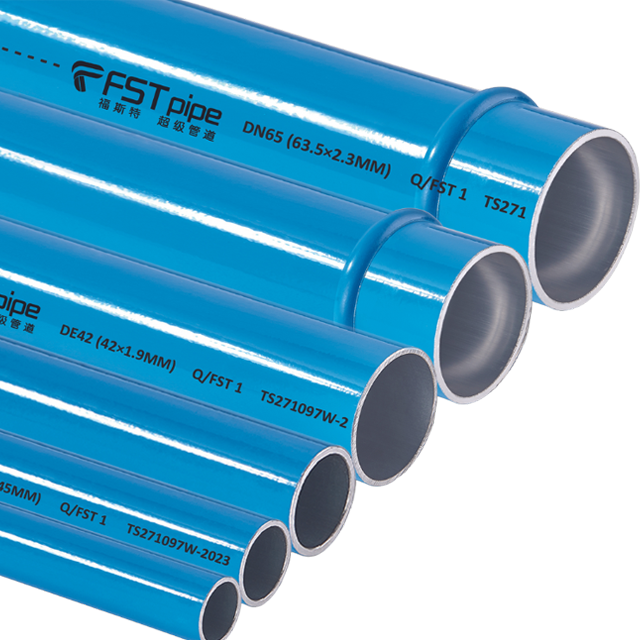
Aluminum Air Piping: This material is revolutionizing compressed air distribution. A Reducing Tee made from aluminum is lightweight, completely resistant to corrosion, and ideal for overhead drops. Unlike heavy steel pipe that requires threading machinery, aluminum systems often use modular connections that reduce installation time by up to 50%.
When designing a system, engineers often face a choice: buy a dedicated reducing tee or build an assembly using a standard tee and a bushing. While the assembly might seem convenient if parts are scarce, the engineering evaluation heavily favors the dedicated fitting.
A dedicated reducing tee is a single, integrated component. Building an equivalent assembly requires a standard tee plus a reducer or bushing. This "Frankenstein" approach introduces immediate risks. A standard reducing tee has three connection points. An assembly can have four or five, depending on the adapters used. Every additional thread or weld is a potential leak path. Furthermore, the labor cost to assemble, seal, and test multiple joints often outweighs the initial purchase price of the correct reducing tee.
Space optimization is another critical factor. Skid packages, HVAC retrofits, and machinery with internal piping have strict spatial constraints. Reducing tees have a significantly smaller physical footprint compared to a tee-plus-reducer assembly, allowing for tighter piping layouts.
Performance wise, bushings often create "dead legs" or abrupt steps in the flow path that generate turbulence. This turbulence causes pressure drop and energy loss. A factory-manufactured reducing tee features smooth, radiused internal transitions that guide the fluid efficiently into the branch. This is particularly vital in vacuum systems, high-purity water loops, and high-velocity steam lines where flow stability is paramount.
From an installer's perspective, the reducing tee is superior. It is self-aligning; there is no need to worry about the reducer being welded slightly off-center. Additionally, thermal insulation is much simpler to apply to a single, contoured fitting than to a bulky assembly of screwed parts.
To ensure you receive the correct component for your application, use this checklist during the specification and procurement process. It prevents the common "right shape, wrong rating" errors that compromise safety.
Pressure Ratings: Ensure the fitting's schedule (e.g., Sch 40, Sch 80) or pressure class (3000lb, 6000lb) matches the weakest point in your piping system. A fitting should never be the limiting factor for system pressure.
End Connections: Verify compatibility. Do not attempt to mix NPT threads with BSPT threads without proper adapters, as this will lead to leaks. For welded systems, ensure the bevel angle matches the pipe.
Compliance: For critical infrastructure, verify that the fittings carry the necessary ASTM or ASME stamps. This certification proves the material composition and pressure testing limits.
Total Cost of Ownership (TCO): Look beyond the sticker price. While a reducing tee might cost slightly more upfront than a cast iron bushing, the installed cost is significantly lower due to reduced welding, threading, and inspection labor.
A reducing tee is far more than a simple connector; it is a vital flow-regulating component that simplifies system architecture and enhances hydraulic efficiency. While equal tees serve the purpose of distribution, reducing tees are essential for efficient branching and pressure management across diverse applications—from heavy industrial steam lines to modern aluminum air piping networks.
When evaluating your piping design, avoid the temptation to fabricate field assemblies using bushings. For critical systems involving high pressure, compressed air, or strict hygiene requirements, always opt for factory-manufactured reducing tees. Whether made via hydraulic bulging or precision casting, these engineered fittings provide the safety, longevity, and performance your facility relies on.
A: In most industry contexts, they are synonyms. However, the term "unequal tee" can technically refer to a tee where the run ports are also different sizes (e.g., A > B > C), whereas "reducing tee" almost always implies the run ports are the same size, and only the branch is smaller. Always check the specific dimensions (A x B x C) to be sure.
A: Yes, you can, but it is not recommended for permanent or high-pressure systems. Using a bushing introduces additional threaded joints, which increases the risk of leaks. It also creates a "step" in the flow path that causes turbulence and pressure drop. A dedicated reducing tee is safer and more efficient.
A: Pressure drop is calculated using the concept of "equivalent length." Manufacturers provide data stating that a specific tee creates friction equivalent to a certain length of straight pipe (e.g., a 4" tee might equal 20 feet of pipe). You add this equivalent length to your total pipe run to calculate total head loss.
A: Yes, they are a core component of modern compressed air systems. Aluminum reducing tees are specifically designed for modular drops. They are lightweight, corrosion-resistant, and typically use compression or luggage-style connections, eliminating the need for threading or welding.
A: Dimensional tolerances are governed by ASME B16.9 for butt weld fittings. For example, for fittings up to NPS 24, the tolerance on the off-angle and off-plane is typically within ±1% to ±2%, ensuring that the fitting can be welded to the pipe without requiring excessive force to align the faces.